
自己紹介・研究目的
令和6年4月入学/ ■SPRING事業 採択学生紹介

生命・臨床医学プログラム
令和6年4月 大学院入学
NGUYEN TIEN MANH
グエン ティエン マン
Molecular mechanisms driving the pathogenesis of the emerging Streptococcus pyogenes M1uk lineage
My name is Nguyen Tien Manh. I am currently a PhD student majoring in Microbiology at the Graduate School of Medicine and Pharmaceutical Sciences, University of Toyama, under the supervision of Professor Yoshitomo Morinaga.
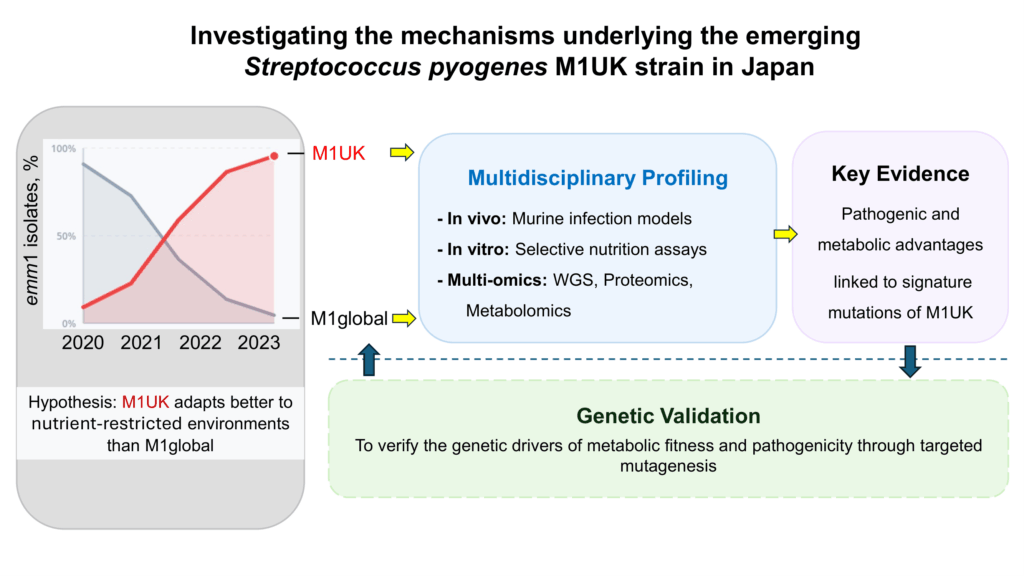
My research focuses on the emerging Streptococcus pyogenes M1UK sublineage in Japan. This variant has been increasingly associated with the global rise in invasive Group A streptococcal (iGAS) infections and appears to possess fitness advantages over the previously predominant M1global strain.
We hypothesize that novel mutations in M1UK enable it to acquire unique survival strategies within the nutrient-restricted environment of the lower respiratory tract. To test this hypothesis, my work compares the in vivo pathogenesis of the M1UK and M1global strains using murine infection models. Furthermore, we aim to elucidate the metabolic mechanisms underlying the variant's heightened invasiveness and transmissibility.
The ultimate goal of this study is to provide genetic evidence that the enhanced virulence of M1UK is driven, at least in part, by metabolic adaptations to nutrient-restricted conditions. These findings may contribute to a deeper understanding of streptococcal pathogenesis and provide an important foundation for the prevention and control of severe bacterial infections.
My research focuses on the emerging Streptococcus pyogenes M1UK sublineage in Japan. This variant has been increasingly associated with the global rise in invasive Group A streptococcal (iGAS) infections and appears to possess fitness advantages over the previously predominant M1global strain.
We hypothesize that novel mutations in M1UK enable it to acquire unique survival strategies within the nutrient-restricted environment of the lower respiratory tract. To test this hypothesis, my work compares the in vivo pathogenesis of the M1UK and M1global strains using murine infection models. Furthermore, we aim to elucidate the metabolic mechanisms underlying the variant's heightened invasiveness and transmissibility.
The ultimate goal of this study is to provide genetic evidence that the enhanced virulence of M1UK is driven, at least in part, by metabolic adaptations to nutrient-restricted conditions. These findings may contribute to a deeper understanding of streptococcal pathogenesis and provide an important foundation for the prevention and control of severe bacterial infections.